
Power & Sizing
How to Size a Generator: A Step-by-Step Guide
Updated June 7, 2026
Undersize a generator and it will stall, overheat, or fail to start your motors; oversize it and you waste money and run it inefficiently (which causes "wet stacking" in diesels). The right size covers your running load plus the surge when your biggest motor starts — with a sensible margin on top.
The short version: add up the running watts of everything that runs at once, add the extra surge of the single largest motor at startup, divide by the power factor to get kVA, then add ~25% spare capacity. The interactive calculator below does this for you.
Generator Sizing Calculator
Estimate the generator rating your loads need. Guidance only — confirm with an engineer.
Recommended (prime)
290 kW
Apparent power
363 kVA
Step 1 — Total your running load
List every appliance, motor, light and device that will run at the same time and add up their running (rated) watts. Nameplate ratings are on the equipment; for a whole building, a rough estimate is about 5 watts per square foot plus 50 kW for general commercial use.
This running total is the power the generator must supply continuously.
Step 2 — Add the largest motor's starting surge
Motors are the reason sizing isn't just simple addition. When an electric motor starts, it briefly draws far more than its running power — the inrush current. You don't add the surge of every motor (they rarely start at the same instant), but you must cover your single largest motor starting while everything else is already running.
The surge depends on how the motor is started:
| Start method | Startup draw | Typical use |
|---|---|---|
| Direct-on-line (DOL) | ~3× running | Most small/medium motors |
| Soft starter | ~2× running | Pumps, conveyors |
| Variable frequency drive (VFD) | ~1.5× running | Modern HVAC, controlled motors |
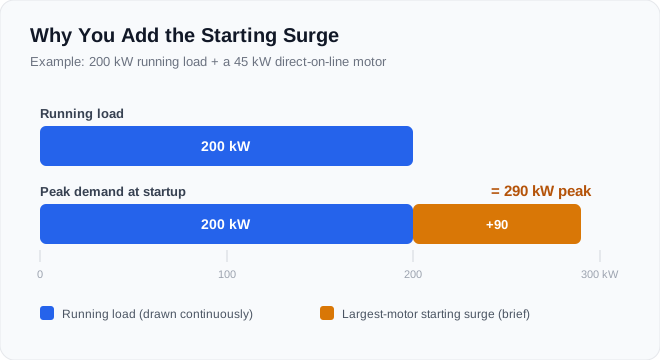
So a 45 kW DOL motor adds about 45 × (3 − 1) = 90 kW of extra startup demand on top of its running power.
Peak demand = total running load + (largest motor running × (start factor − 1))
Step 3 — Convert kW to kVA with power factor
Generators are rated in both kW (real power) and kVA (apparent power). Convert with the standard 0.8 power factor:
kVA = kW ÷ 0.8
(For a deeper explanation, see kVA vs kW vs kWe explained.)
Step 4 — Add a spare-capacity margin
Never size a generator to run flat-out. Industry practice is to leave headroom — typically 25% — so the set normally runs at 70–80% load. This protects against voltage dips (keep them under 15%), absorbs small future additions, and keeps the engine in its efficient, healthy operating band.
Recommended rating = the larger of: peak startup demand, or running load × 1.25
Worked example
A small factory:
- Running load (lights, controls, small machines): 200 kW
- Largest motor: a 45 kW compressor, started direct-on-line (×3)
- Starting surge of the compressor: 45 × (3 − 1) = 90 kW
- Peak demand at startup: 200 + 90 = 290 kW
- Continuous with 25% margin: 200 × 1.25 = 250 kW
- Required rating = max(290, 250) = 290 kW → ÷ 0.8 = ≈ 363 kVA
You'd then look for a genset with a prime rating of at least 290 kWe / 363 kVA — browse the 300–600 kWe range to find matching engines.
Common mistakes to avoid
- Forgetting motor surge — the most frequent cause of undersizing. A generator that's fine on running watts can still fail to start a single large motor.
- Adding every motor's surge — too conservative; only the largest matters.
- Sizing to 100% load — leaves no headroom and shortens engine life.
- Confusing kW and kVA — always check which unit the spec sheet uses.
Next steps
Once you know your target rating, the rest is matching it to real hardware. Browse the catalog by power range, compare prime vs standby ratings, or filter diesel and gas engines by brand. When in doubt on a critical installation, have a qualified engineer confirm the load study.
Related generator guides
kVA vs kW vs kWe: Generator Power Ratings Explained
What kVA, kW, kWe and kWm actually mean on a generator spec sheet, how to convert between them with the 0.8 power factor, and how to read prime vs standby ratings.
Prime vs Standby vs COP vs DCP: Generator Rating Types
The four ISO 8528 generator power ratings — ESP (standby), PRP (prime), COP (continuous) and DCP (data centre) — explained: permitted hours, load type, overload, and which rating to choose.
How to Select a Transfer Switch (ATS): Types, Transitions & Sizing
A practical guide to choosing a generator transfer switch — manual vs automatic, service-entrance and bypass-isolation types, open vs closed transition, NEC load categories, NEMA enclosures and how to size the switch.
Looking for a specific engine?
Browse >1,600 diesel & gas generator engine specs.