
Power & Sizing
Prime vs Standby vs COP vs DCP: Generator Rating Types
Updated June 7, 2026
The same engine can be sold at several different power ratings — and the one you pick depends entirely on how the generator will be used: as rare backup, as a site's only power source, or as a continuous base load. The international standard ISO 8528-1 defines four ratings: ESP, PRP, COP and DCP. Pick the wrong one and you either overpay or overload the set.
The short version: Standby (ESP) is the highest rating, for backup only (≤ 200 hours/year). Prime (PRP) is for unlimited-hours running on a variable load where there's no grid. Continuous (COP) is the lowest rating, for steady 24/7 base load. DCP is a newer rating purpose-built for data centres.
Why there are four ratings
A generator's allowable output is a trade-off against how long and how hard it runs. A set used a few hours a year during outages can be pushed harder than one running 8,760 hours a year. So manufacturers publish multiple ratings for the same engine: the more hours and the steadier the load, the lower the rating.
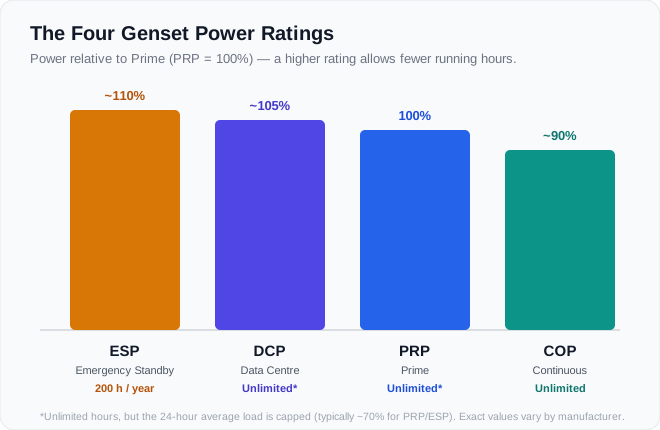
The four ratings
ESP — Emergency Standby Power
The maximum power available during a utility outage, supplying a variable load. An ESP-rated engine may run up to 200 hours per year, with the 24-hour average load not exceeding ~70% of ESP. No overload is permitted. This is the rating for the vast majority of backup gensets — if the mains rarely fails, size on ESP.
PRP — Prime Power
The maximum power for unlimited hours supplying a variable load. The permissible 24-hour average must not exceed ~70% of PRP, and a 10% overload is allowed for 1 hour in every 12. Use Prime where the generator is the main power source and there is no utility — off-grid sites, mining, construction, remote facilities.
COP — Continuous Operating Power
The maximum power for unlimited hours supplying a constant load, with no overload. This is the lowest of the ratings and suits true base-load duty: running 24/7 at a steady output, or operating in parallel with the grid for continuous generation.
DCP — Data Centre Power
A newer rating (ISO 8528-1:2018) for data centres. A DCP-rated engine may run an unlimited number of hours supplying a variable or continuous load, and can back up a reliable utility. It is not intended for sustained utility paralleling. It sits between Prime and Standby — built for facilities that need both high availability and the ability to run for long, frequent periods.
Side-by-side comparison
| ESP Standby | DCP Data Centre | PRP Prime | COP Continuous | |
|---|---|---|---|---|
| Relative power | Highest (~110%) | ~105% | 100% (reference) | Lowest (~90%) |
| Max hours/year | 200 | Unlimited* | Unlimited* | Unlimited |
| Load type | Variable | Variable / continuous | Variable | Constant |
| Overload | None | None | 10% for 1 h / 12 h | None |
| Typical use | Backup power | Data-centre backup | Off-grid prime power | 24/7 base load |
*Unlimited hours, but the 24-hour average load is capped (≈70% for PRP/ESP). Exact figures vary by manufacturer.
How the numbers relate
For the same engine, Standby ≈ 1.10 × Prime. So a genset rated 500 kVA prime is typically around 550 kVA standby. Continuous is lower than prime, and DCP usually sits just above prime. This is why a spec sheet often lists two (or more) figures per frequency — for example, many Baudouin engines publish PRP, ESP and DCP side by side.
Which rating should you choose?
- Grid power present, generator is backup only → size on Standby (ESP). Most common.
- No grid; generator is the primary source, load varies → size on Prime (PRP).
- Steady 24/7 load, or paralleling with the grid → size on Continuous (COP).
- Data centre / mission-critical with long, frequent runs → use DCP.
A common mistake is buying a standby-rated set and then running it as prime — it will be overloaded and wear out fast. When in doubt, choose the lower (more conservative) rating.
Next steps
Now that you know which rating applies, work out the number with the generator sizing guide, brush up on kVA vs kW, or browse the catalog — most engine spec pages list both prime and standby ratings at 50 Hz and 60 Hz.
Related generator guides
kVA vs kW vs kWe: Generator Power Ratings Explained
What kVA, kW, kWe and kWm actually mean on a generator spec sheet, how to convert between them with the 0.8 power factor, and how to read prime vs standby ratings.
How to Size a Generator: A Step-by-Step Guide
How to size a generator for your load: add up running watts, account for the largest motor's starting surge, apply power factor and a spare-capacity margin. Includes an interactive sizing calculator.
How to Select a Transfer Switch (ATS): Types, Transitions & Sizing
A practical guide to choosing a generator transfer switch — manual vs automatic, service-entrance and bypass-isolation types, open vs closed transition, NEC load categories, NEMA enclosures and how to size the switch.
Looking for a specific engine?
Browse >1,600 diesel & gas generator engine specs.