
Alternator Basics
North American Voltage Standards: 120V / 208V / 277V / 480V
Updated June 7, 2026
Spec a generator for North America and you'll meet a wall of voltages — 120, 208, 277, 480. They aren't random: they come from a single relationship in three-phase power. Get them straight and equipment selection becomes simple; get them wrong and you risk damaged gear or a genset that won't serve the load.
The short version: North America runs two main three-phase systems — 120/208V (commercial) and 277/480V (industrial) — both wired in a "Wye". In each, the line-to-line voltage is √3 (≈1.732) times the line-to-neutral voltage.
The formula behind everything
Every North American three-phase voltage pair comes from one equation:
V(L-L) = √3 × V(L-N)
…where V(L-L) is the voltage between any two phases (line-to-line) and V(L-N) is the voltage from a phase to neutral (line-to-neutral). The √3 factor comes from the 120° phase shift between the three phases.
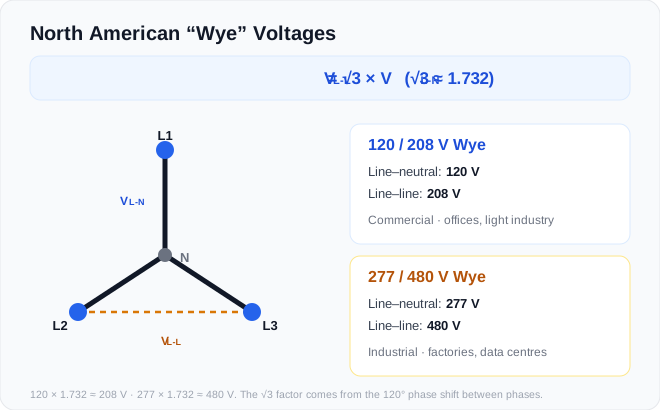
That's why 120 × 1.732 ≈ 208 V and 277 × 1.732 ≈ 480 V.
System 1: 120/208V — the commercial standard
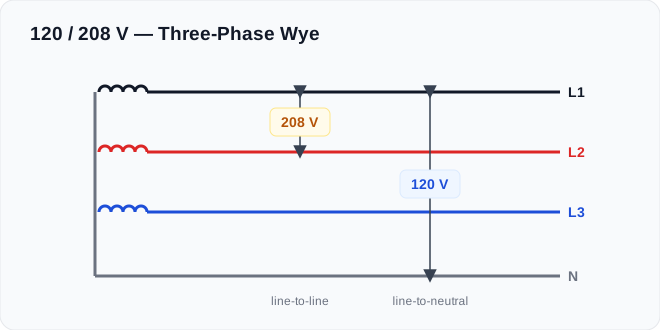
A three-phase, four-wire Wye (plus ground):
- Line-to-neutral: 120 V
- Line-to-line: 208 V
- Where: offices, retail, light industry, multi-tenant residential, small data centres.
Why 208 V and not 240 V? Unlike Europe's 230/400V system, the North American Wye is built from three transformer windings each supplying 120 V. Measure between any two phases and the vectors add to 208 V — not the 240 V you get from a residential split-phase service.
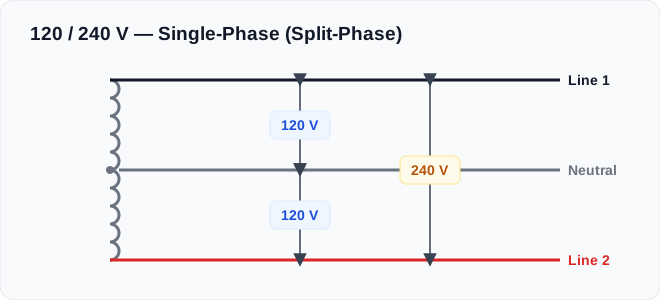
One distribution system then serves both:
- 120 V single-phase loads — outlets, lighting, computers, small appliances.
- 208 V three-phase loads — HVAC, kitchen equipment, elevators, IT infrastructure.
System 2: 277/480V — the industrial workhorse
Also a three-phase, four-wire Wye:
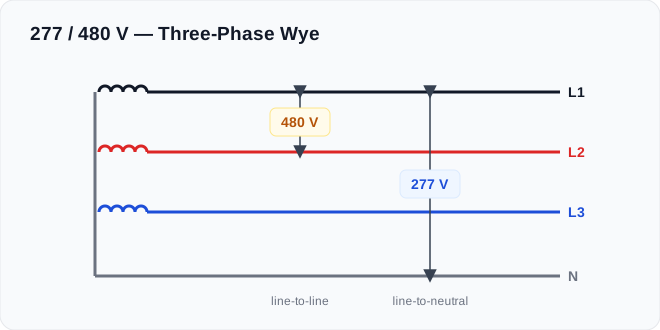
- Line-to-neutral: 277 V
- Line-to-line: 480 V
- Where: large commercial buildings, hospitals, campuses, factories, data centres.
Why 277 V matters: large facilities use 480/277V as the main supply. The 277 V line-to-neutral feeds commercial lighting (fluorescent and LED) directly, avoiding a separate step-down to 120 V for every lighting circuit — a real saving at scale.
Why 480 V wins for power: because power = √3 × V × I × pf, a higher voltage carries the same power at a lower current. At 480 V the current is less than half that of a 208 V system for the same kW — meaning smaller conductors, lower voltage drop over distance, and cheaper cable runs. This is why diesel gensets, UPS systems and transfer switches for industrial sites are commonly 480 V.
347/600V — the Canadian standard
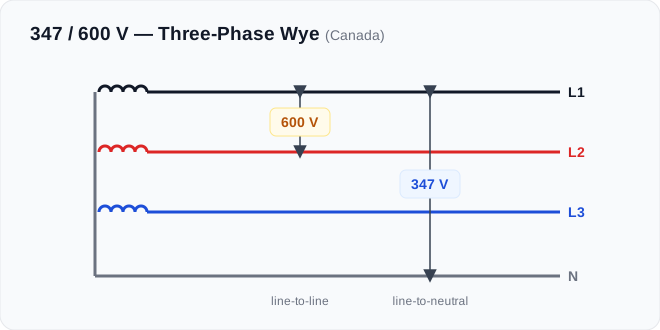
In Canada, large facilities often run 347/600V instead of 277/480V — the same Wye arrangement, scaled up. The line-to-neutral voltage is 347 V (347 × 1.732 ≈ 600) and feeds 347 V lighting, while 600 V line-to-line moves power even more efficiently than 480 V. If you're specifying a genset for a Canadian industrial site, expect 600 V.
The 208V trap: two sources, one number
A common and dangerous mix-up: not every 208 V is the same.
- From a 120/208V Wye: 208 V is the line-to-line voltage, balanced, with a proper neutral. The modern standard.
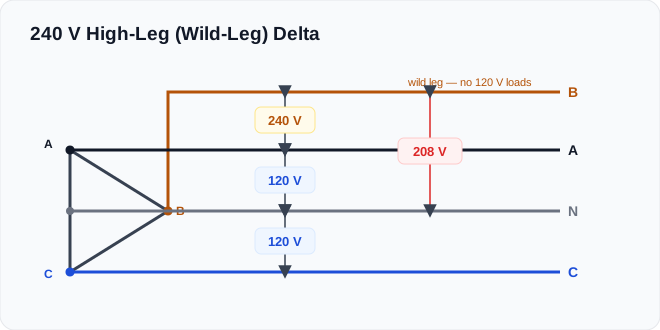
- From a high-leg delta (older systems): a 240 V delta with a center-tapped transformer produces a "high leg" that reads ~208 V to neutral on one phase (the "B" phase) — and that leg must not feed 120 V loads.
A meter reading of "208 V" tells you nothing on its own. Connect 120 V equipment to a high-leg delta and you can destroy it.
Reading the nameplate
The nameplate hints at the system the equipment expects:
| Nameplate | System |
|---|---|
| 208/120 V | 120/208V Wye (four-wire) |
| 277/480 V | 277/480V Wye (four-wire) |
| 347/600 V | 347/600V Wye (four-wire, Canada) |
| 480 V only | Likely three-wire, no neutral |
| 120/240 V | Split-phase, or high-leg delta |
Before connecting, confirm: Is a neutral available? Three-wire or four-wire? Does the load draw line-to-line or line-to-neutral? Are the protective devices rated for the voltage?
Matching the generator
The genset's alternator must be configured for the site's voltage — 208 V or 480 V — and the automatic transfer switch and switchgear must match it. Reconnectable (12-lead) alternators make this easier: one machine can be field-wired across roughly 190–600 V, which is ideal for export and rental fleets serving different sites.
Equipment built for other regions adds a step. A genset wound for 380 V (the common Asian standard) can't be dropped straight onto a 480 V or 208 V system — overvoltage breaks down insulation, undervoltage causes hard starting and lost efficiency — so a voltage-conversion transformer or a reconnected/rewound alternator is required. North America is also 60 Hz (see 50 Hz vs 60 Hz), which must match too.
Quick reference
- V(L-L) = √3 × V(L-N) — the master relationship.
- 120/208V Wye → commercial; serves 120 V single-phase + 208 V three-phase.
- 277/480V Wye → industrial; 277 V lighting, 480 V power at lower current.
- Always confirm the system type, not just the meter reading.
Next steps
Pair this with the alternator voltage & frequency basics, size the genset, then browse the alternator catalogue.
Reference standards: NFPA 70 (NEC), IEC 60038, ANSI/NEMA. For information only — not a substitute for professional electrical engineering advice.
Related generator guides
Alternator Voltage & Frequency: 50 Hz vs 60 Hz
How generator alternators differ by frequency (50 Hz vs 60 Hz, set by poles and RPM) and by voltage output (230/400V, 480V, medium voltage, star vs delta) — and why it matters when choosing a genset.
How to Choose a Generator Engine: Fuel, Power, Frequency & Emissions
A practical buyer's guide to choosing the right generator-set engine — how to weigh fuel type, power rating, frequency, emissions standard, cooling and configuration, with example picks for each size class.
How to Size a Generator: A Step-by-Step Guide
How to size a generator for your load: add up running watts, account for the largest motor's starting surge, apply power factor and a spare-capacity margin. Includes an interactive sizing calculator.
Looking for a specific engine?
Browse >1,600 diesel & gas generator engine specs.