
Alternator Basics
Alternator Voltage & Frequency: 50 Hz vs 60 Hz
Updated June 7, 2026
Two genset alternators can look identical and still be incompatible — because they put out different frequency or voltage. Both are set by how the alternator is built and wired, and both must match the equipment they'll power. Here's how each one works.
The short version: frequency (50 Hz or 60 Hz) is fixed by the alternator's pole count and the engine's speed — a 4-pole set runs at 1,500 RPM for 50 Hz or 1,800 RPM for 60 Hz. Voltage is set by how the windings are wound and connected, and ranges from 400 V low-voltage up to several kilovolts.
Frequency: 50 Hz vs 60 Hz
Frequency is how many times per second the AC waveform cycles. In an alternator it's a direct result of two things — the number of magnetic poles and the speed the engine turns it:
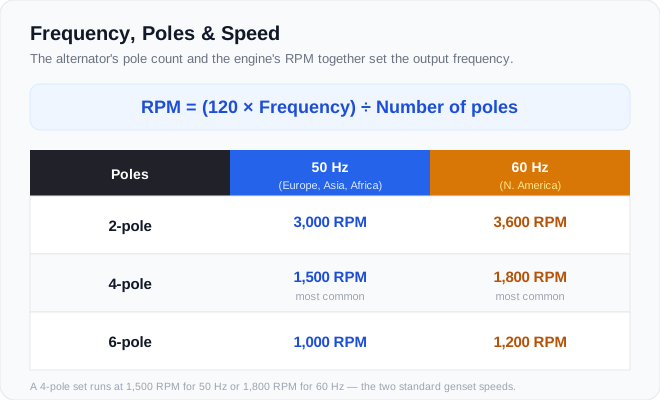
So the same engine can produce 50 Hz or 60 Hz simply by running at a different speed — but a given genset is configured for one or the other; you can't flip a switch between them. Because 60 Hz means a higher speed (1,800 vs 1,500 RPM), an engine typically makes about 20% more power at 60 Hz than at 50 Hz.
Which region uses what:
- 50 Hz — Europe, most of Asia, Africa, Australia, and much of South America.
- 60 Hz — North America, parts of South America, Saudi Arabia, South Korea, the Philippines and Taiwan.
This matters because motors and equipment are frequency-specific: a 60 Hz motor runs ~17% slower (and can overheat) on 50 Hz. Always match the genset's frequency to the local grid and the connected load.
Voltage output
Voltage is set by the alternator's windings and how they're connected. Genset alternators fall into two broad classes:
- Low voltage (LV) — up to ~1,000 V. This covers almost all standard gensets. Common outputs are 230/400 V (Europe), 240/415 V (UK, Australia), 220/380 V (China) at 50 Hz, and 277/480 V or 120/208 V at 60 Hz.
- Medium voltage (MV) — roughly 3.3 kV, 6.6 kV, 11 kV or 13.8 kV, used on large gensets and power plants where high current at low voltage would be impractical.
Three-phase, star and delta
Most commercial gensets are three-phase. The voltage between two phases (the line voltage) and the voltage from a phase to neutral (the phase voltage) differ by a factor of √3 — which is why "400 V" three-phase also gives "230 V" single-phase from phase to neutral.
How the three windings are joined sets the available voltages:
- Star (wye) — provides a neutral, giving both line and phase voltages (e.g. 400 V and 230 V).
- Delta — provides the line voltage only.
- Reconnectable (12-lead) alternators can be field-wired in different star/delta, series/parallel combinations to deliver a range of voltages (commonly ~190–600 V) from one machine — handy for export and rental fleets.
(All ratings assume a 0.8 power factor, as explained in kVA vs kW.)
Why one model has many data sheets
Because each voltage winding and each frequency is a distinct configuration, a single alternator model is published as many technical data sheets — one per winding, pole count and frequency. That's exactly how the alternator catalogue links them: pick a model and you'll find the manufacturer's data sheets covering all of its voltage and frequency options.
Choosing the right alternator
- Frequency — match your region's grid: 50 Hz or 60 Hz.
- Voltage — match your distribution system (e.g. 400 V in Europe, 480 V in North America).
- Phase — three-phase for commercial/industrial; single-phase only for small residential loads.
- kVA — size it to the load (see the sizing guide).
Next steps
Browse the alternator catalogue by series, pole count and kVA, brush up on kVA vs kW, or learn the prime vs standby ratings that apply to alternators too.
Related generator guides
North American Voltage Standards: 120V / 208V / 277V / 480V
Understand North American three-phase voltage systems: the V(L-L) = √3 × V(L-N) formula, the 120/208V and 277/480V Wye systems, the 208V high-leg-delta trap, and how to match a generator to the facility.
How to Choose a Generator Engine: Fuel, Power, Frequency & Emissions
A practical buyer's guide to choosing the right generator-set engine — how to weigh fuel type, power rating, frequency, emissions standard, cooling and configuration, with example picks for each size class.
How to Size a Generator: A Step-by-Step Guide
How to size a generator for your load: add up running watts, account for the largest motor's starting surge, apply power factor and a spare-capacity margin. Includes an interactive sizing calculator.
Looking for a specific engine?
Browse >1,600 diesel & gas generator engine specs.