
Choosing an Engine
Air-Cooled vs Water-Cooled Engines: Pros, Cons & Lifespan
Updated June 7, 2026
Every engine turns most of its fuel into heat, and that heat has to go somewhere. How an engine sheds it — straight to the air, or through circulating coolant — shapes its size, noise, maintenance and, above all, how long it lasts under load. Here's the difference and how to choose.
The short version: air-cooled engines are simpler, lighter and cheaper, and shine in small, portable or occasional-use sets. Water-cooled (liquid-cooled) engines hold a steadier temperature, run quieter and last far longer under continuous, heavy load — which is why nearly every commercial and industrial genset is water-cooled.
How each one works
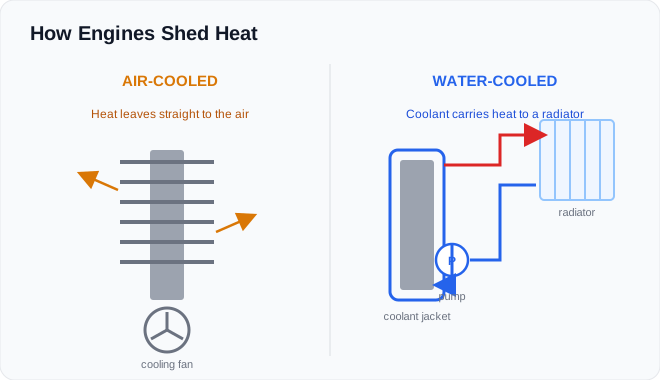
- Air-cooled — the cylinders are covered in fins that increase surface area, and a fan blows air across them to carry the heat away. No coolant, radiator or water pump.
- Water-cooled — coolant circulates through a jacket around the cylinders, absorbs the heat, and a water pump sends it to a radiator where a fan cools it before it returns. A thermostat holds the temperature in a tight band.
Air-cooled engines
Pros
- Simple and reliable — no radiator, pump, hoses or coolant, so there's less to fail or maintain.
- Lighter and more compact, with a lower upfront cost.
- No coolant to freeze, leak or top up — an advantage in very cold or remote conditions.
Cons
- Less precise temperature control — they run hotter and with bigger temperature swings under load.
- Noisier, because the cooling fan is loud and there's less mass to damp sound.
- Limited to lower power and to intermittent duty; they derate in hot ambient air.
Typical use: small portable generators, light-duty and standby sets, and rugged small industrial engines (e.g. Deutz, Hatz). Mostly below ~50 kW.
Water-cooled (liquid-cooled) engines
Pros
- Stable, precise temperature across all loads — the key to long life and efficient combustion.
- Quieter, with the coolant and enclosure damping noise.
- Handles continuous, heavy load and scales to multi-megawatt power; copes better with hot climates.
Cons
- More complex — radiator, pump, hoses, thermostat and coolant are extra parts to maintain.
- Coolant maintenance (antifreeze, flushing) and the risk of leaks or freezing.
- Heavier and higher upfront cost.
Typical use: virtually all commercial and industrial generator sets, and anything that runs continuously or above a few tens of kW.
Lifespan and durability
This is where the two really diverge:
- A water-cooled engine holds a near-constant operating temperature, so it suffers far less thermal stress. Under continuous or heavy duty it lasts much longer — large industrial diesels routinely run 20,000–30,000+ hours before overhaul. This is why every prime and standby genset of any size is liquid-cooled.
- An air-cooled engine has fewer parts to fail and is extremely dependable for light or intermittent use. But the higher operating temperatures and larger temperature swings under sustained heavy load accelerate wear, so its working life is shorter when pushed hard.
In short: air-cooled wins on simplicity for light duty; water-cooled wins on longevity under load.
Side-by-side comparison
| Air-Cooled | Water-Cooled | |
|---|---|---|
| Mechanism | Finned cylinders + fan | Coolant jacket + radiator + pump |
| Complexity | Simple, few parts | More parts, more maintenance |
| Temperature control | Less precise, runs hot | Precise and stable |
| Noise | Louder | Quieter |
| Cold weather | No coolant to freeze | Needs antifreeze |
| Continuous / heavy load | Limited | Excellent |
| Power range | Mostly < ~50 kW | Small to multi-MW |
| Lifespan under load | Shorter | Longer |
| Typical use | Portable, light/standby | Commercial & industrial gensets |
Which should you choose?
- Small, portable or occasional power → air-cooled. Simple, light, dependable and cheap.
- Continuous, heavy, commercial or industrial duty (or a hot climate) → water-cooled.
For almost any genset that matters — backup or prime, a few tens of kW and up — water-cooled is the standard. That's reflected in this catalogue: nearly every engine listed is liquid-cooled.
Next steps
Match the fuel type and size to your application, then browse the engine catalogue — each spec page lists the cooling method alongside the power ratings.
Related generator guides
How to Choose a Generator Engine: Fuel, Power, Frequency & Emissions
A practical buyer's guide to choosing the right generator-set engine — how to weigh fuel type, power rating, frequency, emissions standard, cooling and configuration, with example picks for each size class.
Gasoline vs Diesel vs Natural Gas Generator Engines
Compare gasoline, diesel and natural gas generator engines — power range, efficiency, fuel cost, emissions, durability and best use — so you can pick the right fuel for your application.
Diesel Generator EPA Emission Standards Explained
EPA diesel backup generator standards explained for standby and prime power buyers, including Tier 2, Tier 3, Tier 4 Final, emergency standby rules, and quote inputs.
Looking for a specific engine?
Browse >1,600 diesel & gas generator engine specs.