
Choosing an Engine
Gasoline vs Diesel vs Natural Gas Generator Engines
Updated June 7, 2026
The fuel an engine burns shapes almost everything about a generator: its size, running cost, emissions, lifespan and what it's good for. The three common choices are gasoline, diesel and natural gas — and they sit in very different places.
The short version: gasoline suits small portable sets; diesel is the workhorse for backup and prime power across the widest range of sizes; natural gas wins for continuous, lower-emission power where a gas supply is available.
Why fuel choice matters
A generator is matched to a duty. A homeowner needing occasional power has nothing in common with a hospital needing instant, reliable backup, or a data centre running gensets for thousands of hours. Fuel is the first fork in that decision — it sets the practical size range and the economics.
Gasoline (petrol)
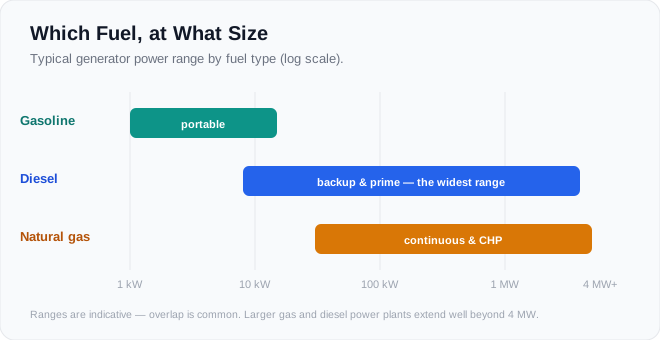
Gasoline engines are spark-ignited and almost always found in small, portable generators — typically under ~15 kW for homes, job sites and recreation.
- Pros: cheap, lightweight and portable; low upfront cost.
- Cons: lower efficiency and shorter lifespan; gasoline is volatile and degrades in storage (months, not years); higher running cost; not suited to continuous or heavy-duty use.
- Best for: occasional, portable, residential-scale power.
Gasoline is rare in commercial/industrial gensets, which is why this catalogue focuses on diesel and gas.
Diesel
Diesel engines use compression ignition and are the backbone of the generator world, powering sets from around 10 kW to over 4 MW.
- Pros: the highest efficiency and fuel economy; rugged and long-lived; high power density and strong response under load; diesel fuel stores well and is widely available; proven for both standby and prime duty.
- Cons: higher upfront cost; more NOx and particulate emissions (modern Tier 4 / Stage V engines add aftertreatment); louder; requires on-site fuel storage.
- Best for: the majority of applications — backup power, construction, off-grid prime power, and anything where reliability matters most.
Browse diesel engines in the catalogue.
Natural gas (and biogas)
Natural gas engines are spark-ignited, usually lean-burn, and run on pipeline gas, LNG/CNG, or renewable biogas.
- Pros: the cleanest emissions (lower NOx, particulates and CO₂ — especially on biogas); low fuel cost where pipeline gas is cheap; no on-site fuel storage when piped; ideal for continuous power and combined heat & power (CHP).
- Cons: lower power density (a bigger engine for the same kW); depends on a gas supply, so it's harder to use for instant standby unless gas is guaranteed; slightly lower efficiency and slower load acceptance than diesel.
- Best for: continuous/base-load generation, CHP, low-emission zones, and sites with abundant or cheap gas.
Browse gas engines in the catalogue.
Side-by-side comparison
| Gasoline | Diesel | Natural Gas | |
|---|---|---|---|
| Ignition | Spark | Compression | Spark (lean-burn) |
| Typical size | < 15 kW (portable) | 10 kW – 4 MW+ | 30 kW – several MW |
| Efficiency | Low | Highest | Medium |
| Fuel cost | High | Medium | Low (pipeline) |
| Emissions | Moderate | Higher (NOx/PM) | Lowest |
| Durability | Short | Longest | Long |
| Fuel storage | Volatile, short shelf life | Stores well | Pipeline / LNG / CNG |
| Best for | Portable, residential | Backup & prime, all sizes | Continuous, CHP, low-emission |
Which should you choose?
- Need reliable backup, any size? → Diesel. It starts fast, runs hard, and stores its fuel.
- Running continuously with cheap gas, and emissions matter? → Natural gas.
- Small, occasional, portable power? → Gasoline.
For most standby and prime installations, diesel remains the default; natural gas is the choice when you're running long hours, want lower emissions, or have a cost-effective gas supply.
Next steps
Once you've picked a fuel, work out the size with the generator sizing guide, understand the prime vs standby ratings, or filter the catalogue by diesel or gas.
Related generator guides
How to Choose a Generator Engine: Fuel, Power, Frequency & Emissions
A practical buyer's guide to choosing the right generator-set engine — how to weigh fuel type, power rating, frequency, emissions standard, cooling and configuration, with example picks for each size class.
Diesel Generator EPA Emission Standards Explained
EPA diesel backup generator standards explained for standby and prime power buyers, including Tier 2, Tier 3, Tier 4 Final, emergency standby rules, and quote inputs.
Air-Cooled vs Water-Cooled Engines: Pros, Cons & Lifespan
How air-cooled and water-cooled (liquid-cooled) generator engines differ — how each sheds heat, their pros and cons, durability and lifespan, and which to choose for your application.
Looking for a specific engine?
Browse >1,600 diesel & gas generator engine specs.