
Choosing an Engine
How to Read an Engine Nameplate & Spec Sheet
Updated June 7, 2026
Two documents tell you everything about a generator engine: the nameplate bolted to the engine, and the spec sheet (data sheet) that comes with it. The nameplate identifies the exact unit in front of you; the spec sheet tells you what it can do. Once you can read both, buying, servicing and matching an engine gets a lot easier.
The short version: the nameplate gives the model, serial number, rated power and emission certification of that specific engine. The spec sheet gives the full performance picture — prime and standby power at 50/60 Hz, displacement, cylinders, speed and more.
Part 1 — The nameplate (data plate)
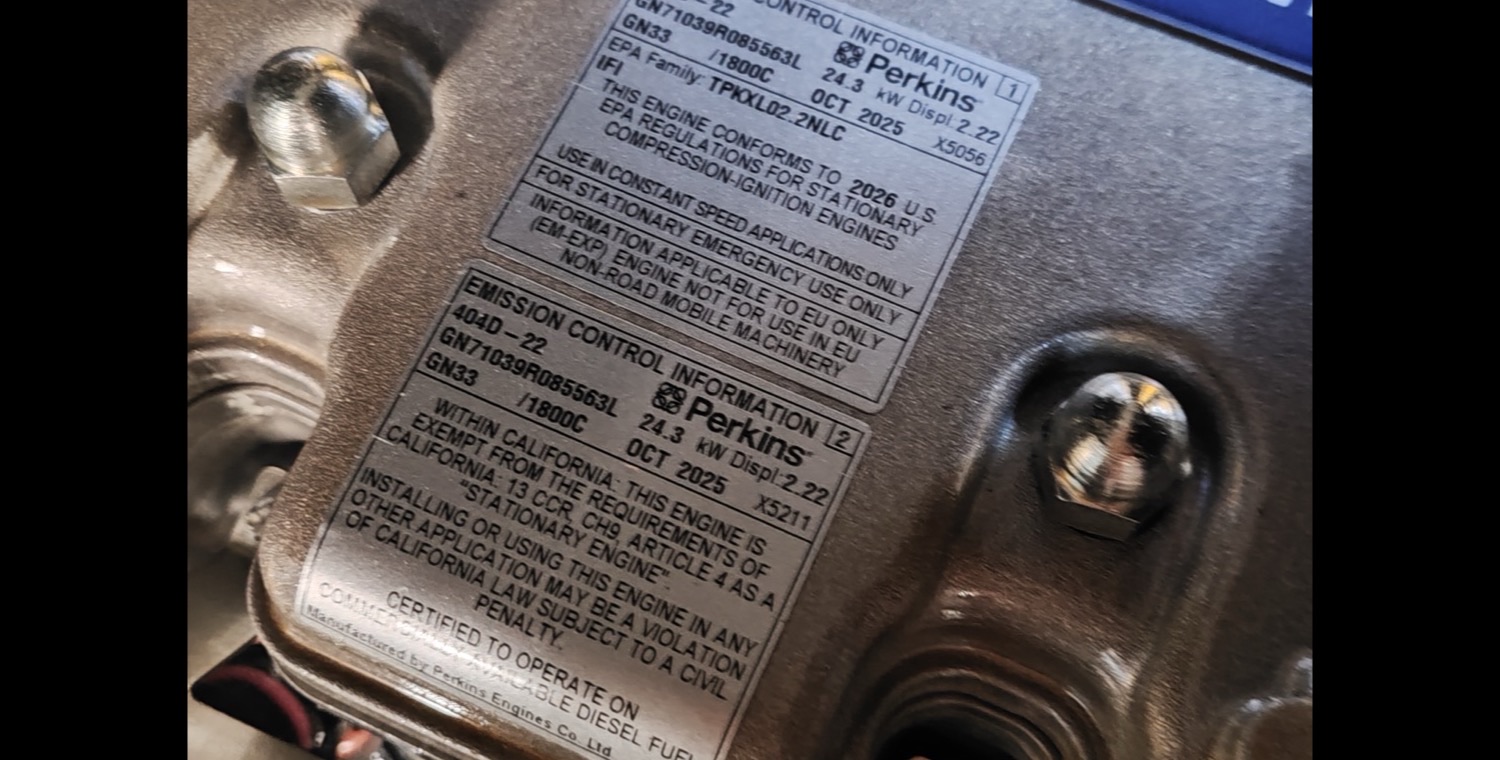
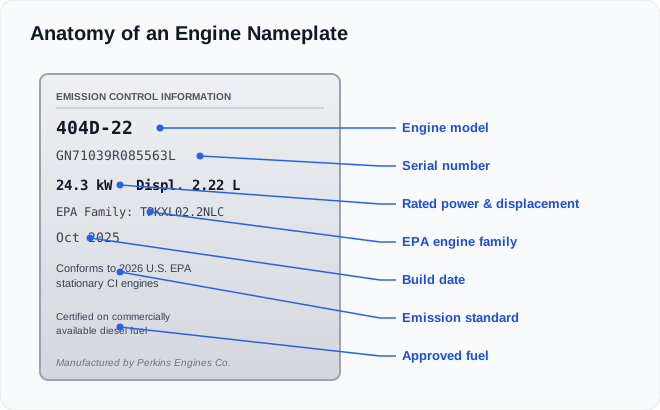
The nameplate is the metal plate fixed to the engine block. It's the engine's identity card: you need it for ordering parts, validating warranty, and proving emissions compliance. Here's how the fields break down — the photo above is a real Perkins 404D-22 plate.
- Engine model (
404D-22) — the manufacturer's model. Perkins's code even encodes the engine: 4 cylinders, D for diesel, 2.2 litres. - Serial number (
GN71039R085563L) — unique to this one engine. Quote it for spare parts and warranty. - Rated power (
24.3 kW) — the engine's rated mechanical output. Note this is engine kW, not the genset's electrical kWe (see kVA vs kW). - Displacement (
2.22 L) — total swept volume of the cylinders. - EPA engine family (
TPKXL02.2NLC) — the EPA certification family that groups engines of the same emissions design. - Build date (
Oct 2025) — when it was manufactured. - Emission standard — here, "conforms to 2026 U.S. EPA regulations for stationary compression-ignition engines," flagged for emergency use only (with a California-specific note). This tells you where and how the engine is legal to run — see EPA emission standards.
- Approved fuel — "commercially available diesel fuel."
The plate's wording matters: "stationary emergency use only" or "not for non-road mobile machinery" defines the legal application. Installing an engine outside its certified use can carry penalties.
Part 2 — The spec sheet (data sheet)
The spec sheet is the document that describes what the engine can do. The most important section is the power ratings, which is also the most misread.
Power ratings
A genset spec sheet usually lists several numbers per frequency:
| Term | Meaning |
|---|---|
| kWm | Mechanical power at the engine flywheel |
| kWe | Electrical power after alternator/fan losses |
| kVA | Apparent power (kWe ÷ 0.8 power factor) |
| Prime (PRP) | Unlimited-hours rating for a variable load |
| Standby (ESP) | Backup-only rating (~200 h/year), usually ~10% higher |
| 50 Hz / 60 Hz | 1,500 rpm vs 1,800 rpm (for a 4-pole set) |
So "500 kVA standby / 400 kWe prime at 50 Hz" is four facts in one line. If you're unsure which to use, see prime vs standby and kVA vs kW.
Watch for the basis: ratings may be quoted net (with fan) or gross, which changes the number — always compare like with like.
Engine and performance data
The rest of the sheet describes the hardware:
- Cylinders & configuration — e.g. inline-6 (L6) or V12.
- Bore × stroke, displacement and compression ratio.
- Aspiration — naturally aspirated, turbocharged, or turbo + intercooled.
- Cooling — liquid- or air-cooled (see air vs water cooling).
- Rated speed — the rpm, which pins the frequency (1,500 = 50 Hz, 1,800 = 60 Hz).
- Fuel consumption — usually litres/hour at several load points.
- Emission standard — e.g. U.S. EPA Tier, EU Stage V, or China stage.
- Weight and dimensions of the engine (or the genset).
Putting it together
Use the nameplate to confirm exactly what you have (and that it's certified for your application), and the spec sheet to confirm it does what you need:
- Model + serial → identify and order parts.
- Emission line → check it's legal where you'll run it.
- Power ratings → match prime/standby kWe & kVA to your load.
- Speed/frequency → match your grid (50 or 60 Hz).
- Cooling, weight, dimensions → check it fits the installation.
Every engine page in this catalogue lays these out the same way — power ratings, displacement, cylinders, cooling and emissions — and links the manufacturer's spec sheet where available.
Next steps
Brush up on kVA vs kW and prime vs standby, then browse the engine catalogue and read a few spec pages with this guide open.
Use your nameplate to check model-specific parts
These engine pages include reviewed part references. Match the model on your nameplate, then check the serial number and configuration requirements before ordering.
Related generator guides
How to Choose a Generator Engine: Fuel, Power, Frequency & Emissions
A practical buyer's guide to choosing the right generator-set engine — how to weigh fuel type, power rating, frequency, emissions standard, cooling and configuration, with example picks for each size class.
Gasoline vs Diesel vs Natural Gas Generator Engines
Compare gasoline, diesel and natural gas generator engines — power range, efficiency, fuel cost, emissions, durability and best use — so you can pick the right fuel for your application.
Diesel Generator EPA Emission Standards Explained
EPA diesel backup generator standards explained for standby and prime power buyers, including Tier 2, Tier 3, Tier 4 Final, emergency standby rules, and quote inputs.
Looking for a specific engine?
Browse >1,600 diesel & gas generator engine specs.